Focus Quebec exhibition

A look at contemporary digital creation in Quebec, featuring works that explore artificial intelligence, the role of nature in our technological society, robotics, and interactivity.



Overview


Information
Emma Forgues & Sam Bourgault, body circuit / parcours corporel (2023), 3D printing, silicone, thermoplastic polyuréthane (TPU), electronic and robotic components, dimensions varies
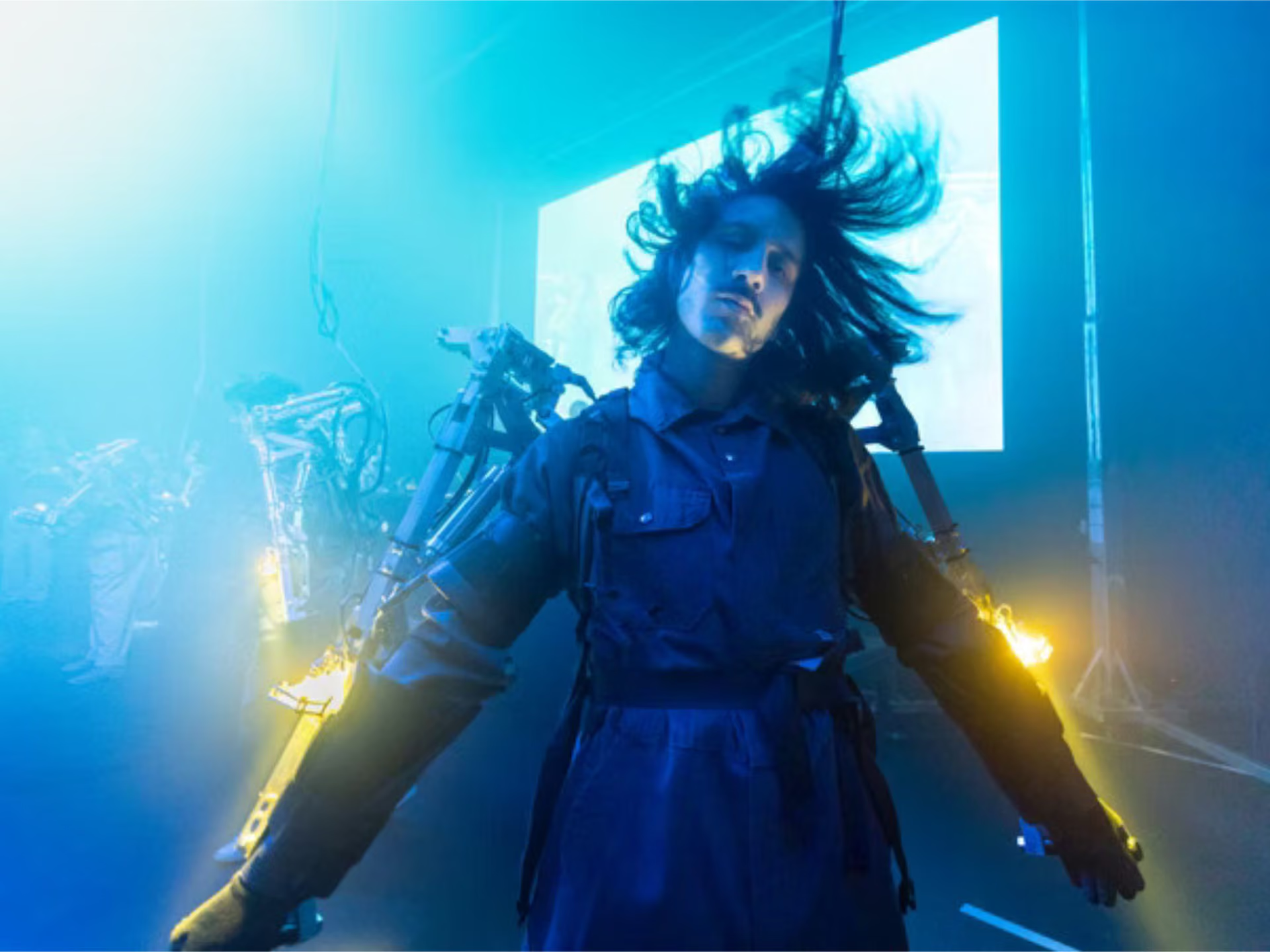
body circuit / parcours corporel is a kinetic installation that explores human-robot interactions through sensory encounters. In a haptic network, soft machines housed in organically shaped ceramic vessels pinch, inflate and caress disarticulated human limbs, molded from the artists' bodies. Pneumatic tubes and electroluminescent wires establish connections between the zones of interaction. This work creates a unique space where soft and delicate entities intertwine with rigid and complex bodies, offering both tenderness and support. It presents an alternative world where technology and relationships with the human body revolve around the concept of care.
Louis-Philippe Rondeau, Veillance, (2023), television, camera, aluminium, acrylic, electronics, computer, 210 cm x 120 cm x 20 cm
Veillance is an interactive installation that performs a full-size scan of individuals on a large screen. In doing so, it makes an inventory of all the people it has interacted with in a vast mosaic. Developed by Steve Mann, the concept of veillance is the state of mutual scrutiny that arises between citizens and institutions constantly snooping on each other. In Veillance, while we contemplate the scanned images of other individuals, the installation captures our portrait – and adds it to its archive. However, given the nature of the scanning process, we can evade capture via our gestures – altering our appearance over time – thereby hijacking the scanography process.
Baron Lanteigne (2023), Cinematography of Virtual Matter, video installation, dimensions varies
The flexibility of the digital invites the artist to discard the need to create a work as an end in itself. Cinématographie de la Matière Virtuelle is a connected system that exploits the interoperability of digital creation tools to form a fragile, alterable and ephemeral network. In this system, 3D tools created with the intention of simulating the real are diverted to reveal reversible properties of their own, qualified as "virtual matter" by the artist. These procedural systems are first created to better explore the properties of matter and remain connected to a filtered, cryptic or even inaccessible interaction with the public. This indirect relationship with the system stimulates this material in real time thanks to a crossing between geometries, textures, materials, lighting and virtual cameras. Thus, the system is a playground to explore the border between the figurative image and the abstraction that comes from the imperfections of this cinematography.
Samule St-Aubin, (2017), Prosperity, Spaghetti, stand-alone system
Prosperity is an autonomous device that manipulates grains of rice. A clamp moves from one surface to another, picking up randomly placed grains and then depositing them in an orderly manner on a second surface. This process aligns them while preserving their initial orientation. The work highlights the exchanges between the machine and the material, which imposes its constraints on the machine, which must continually repeat the sequences of analysis and movement.
In Spaghetti, the viewer is confronted with a machine that compresses a strand of spaghetti with precision until it inevitably breaks. By watching this process, the viewer feels as though their own psychological and bodily tension is being transferred to the machine, experiencing the sensation of the body being subjected to pressure. Through this machine performance, the artist explores themes of technology, the body, and humanity's relationship with machines in an increasingly automated world
Matthew Biederman, (2017), Generative Adversarial Network (millimeter wave)
This work takes its name from the software framework used to create its imagery as a self-referential point in order to reveal not only how the images are created, but also how the idea of the public has shifted in a so-called free society. The parameters of what constitutes an adversary are constantly shifting depending on the context and perspective, but within machinic perception, they remain fixed within the biases of its programmers and the dataset, or society and their polity. For ‘A Generative Adversarial Network’ a machine-learning algorithm was trained with a dataset gleaned from millimeter-wave security scans. Rather than using it for security screening as intended, the algorithm creates new images of imaginary people. This methodology of AI creates new images from random noise by continually updating and re-evaluating the imagery, at times breaking down, becoming confused and starting over - not unlike our global security apparatus.
Katherine Melançon (2017), Fauna - Seven Sisters National Park series,
The video work has the Seven Sisters National Park (England) still life series as a starting point. The series was created following my visit in 2013. The works attempt to translate the uncanniness of the place; mountains and shores made of chalk that the sea erodes with its come and go. My video works are always slow to impose slowing down, to mimic the rhythm of plants and to reward the gaze that looks with attention
Sabrina Ratté (2022), Objets-monde, dimensions varies
Objets-monde is interested in the traces that humans leave on the environment as well as the way in which these become an intrinsic part of our ecosystem. Abandoned objects, such as cars and computer screens, were captured with the help of photogrammetry to create a video collage composed of extracts from reality. Re-contextualized in disproportionately large proportions within landscapes seen from afar, these objects stand out like the ruins of monumental architecture. The absence of life as well as the luminous atmosphere of the work create a tension between apocalyptic feeling and nostalgia, between precious object and waste, between idealized nature and the indelible presence of human traces. These vestiges of the Anthropocene are deployed within an interactive installation in collaboration with Guillaume Arseneault, and a soundtrack composed by Roger Tellier-Craig. This is the single-channel version of the project.
Sabrina Ratté, Radiances IV & Radiances V, 2018, 56x100cm
Radiances is a formal research aimed at creating a parallel between the aesthetics of the digital image and that of traditional painting. A combination of various techniques was used, such as 3D animation, video synthesis and digital manipulations, to bring out textures which evoke, without imitating, layers of paint, brush strokes, reliefs. These paintings in motion suggest a contemplative state where landscapes evolve slowly over time, freeing the observer from a narrative and linear montage, while maintaining the temporal aspect of the video.
Sabrina Ratté, Inscape, 2019, Impression installation, 115x172cm
Inscape is a single channel video mixing 3D animation and video synthesis. By an interplay between points of views, depth of fields and textures, new details are revealed, transforming the space into abstract compositions. Inspired by the paintings of Kay Sage, Inscape depicts a psychological landscape, where perspectives are constantly shifting.
Oli Sorenson (2020-21), Chaîne logistique, digital print, 90x90 cm
Oli Sorenson presents Chaîne logistique, a sequence of animations composed of simple geometric shapes in extremely vivid colors. Created in a hybrid style, this video recalls the square layout of Instagram, the pixelated landscapes of Minecraft as much as the works of american painter Peter Halley. Sorenson’s images thus feature a multitude of scenes, both abstract and figurative, to illustrate the ubiquity of networks that exert controls over our social relationships. Among these fiber optic matrices that feed the global digital economy, the artist tries to interweave other networks of roads, shipping lanes, pipelines, electrical cables and sewers, as well as the atmosphere saturated with WiFi and Bluetooth signals, in addition to carbon polluants and pesticides. These conduits and many others contribute to an acceleration of consumption flows at the heart of contemporary societies, particularly through the rapid obsolescence of technological devices, and other sectors of human activity which are accumulating on ever-increasing areas of land and sea, to the point of causing urgent ecological repercussions.
Venue
Forum des images