.png)

EVENING #3
Temitope Olujobi, Wonwoori, Tacit Group (Gazaebal)
Saturday, June 20
HOURS
Doors open: 7:30pm
Start of the evening: 8pm
PRICE
General Admission: 20$
Student rate: 15$
3 evenings pass: 50$
VENUE
PHI, 407 Rue Saint-Pierre
Montréal, QC H2Y 2M3
→ Directions

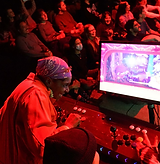
Hands That Steal From "Other" Mouths
A theatrical two-player satire about Western empire and extraction, “Hands that Steal from ‘Other’ Mouths” combines live video game performance, electro-pop music and a teach-in on the unequal exchange between the global North and South. The project began as a commission for Meow Wolf that personifies the exploitative relationship between an anthropomorphic mouth (global South) and hand (global North). Since its button mashing beginnings, the project transformed from an arcade game, into an explosive show and geopolitical history lesson that feels like a concert and class at the same time.
“Using the same characters and controls from the original arcade game, I create new gameplay embedded in a series of animated musical environments featuring a disembodied narrator who sarcastically details how western hands set up exploitative systems.”
The community teach-in is used to explain real world key-points necessary to understand how the geopolitical topic discussed relate to the arcade game.
%20-%20Temitope%20Olujobi.png)
Temitope Olujobi
Austin (Texas) and New-York City (New-York), USA
Temitope Olujobi is an Architect turned Game Designer making games in the creases of completely cracked combinations. They use their design to feed their curiosity about the connection between two seemingly disparate parts. What happens when you combine human shit with a windmill? Restorative Justice with a holodeck? An anthropomorphic hand and mouth with the dreamy triptychs of Hieronymus Bosch? These are all questions Temi has attempted to answer with their video games in some uncanny ways.
Franken Tacit
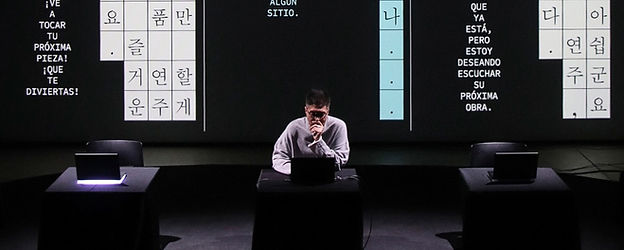
The new work 〈FrankenTacit〉 is a cryptic, 45-minute collaboration with an "AI Monster" that has been trained on the unique aesthetics of Tacit Group. Two AI performers, brought to life through machine learning, integrate with the artist in real-time. Although only one artist stands on stage, they deliver an overwhelming density of energy as if three distinct performers were breathing and creating in unison.
The performance begins with an upgraded version of 'Vertical Hunminjeongak,' where the artist engages in a dialogue with two AI performers, transposing language into a landscape of sound. In 'Game Over 2026,' the artist competes in a game with the two AIs while simultaneously generating music, demonstrating the raw dynamism of the system. Reaching the narrative peak in 'System 4.0,' the artist utilizes live coding alongside the AI performers—who have learned his artistic DNA—to masterfully control the complex emotions on stage and the collective breath of the audience.
Condensed with sophisticated design and visual aesthetics, this experiment opens a new horizon for symbiosis between artist and AI. It serves as a powerful preview of future art at the critical threshold where technology expands the boundaries of human potential.
Design: Sunhee Yang, Ohyun Kwon
Programming: Jay Ho

Tacit Group
Seoul, South Korea
Formed in Seoul in 2008, Tacit Group has been translating contemporary technology into the language of performance, integrating coding, algorithms, live coding, and real-time visuals. Their work originates from the creative displacement of everyday elements—such as games and digital chats—into the realm of algorithmic art, extracting a futuristic sensibility from the fragments of the mundane. Tacit Group’s trajectory goes beyond the mere instrumentalization of technology. They construct systems as artistic organisms, defining a new syntax for media art.

Symbiotic Response
An Audio-Visual Performance for Human and Machine
WONWOORI presents Symbiotic Response at Elektra Montréal, exploring the sensory relationship between human and computer. Building on his research into the mechanical hearing of cochlear implant users, the performance investigates the process of Symbiotic Listening. It examines three fundamental questions: how computers perceive human sound, how humans hear machine-generated audio, and the potential for shared musical enjoyment. Using corpus-based analysis and machine learning, the work fosters a dialogue of mutual listening, seeking a space where humans and AI coexist through sound.

WONWOORI
Seoul, South Korea
Composer WONWOORI expands human potential with Music and Technology. For composer WONWOORI, computer music is a medium for understanding the world around us and humans. The world we live in and humans are often so complex that it is difficult to understand. Composer WONWOORI put the data of the object to be interpreted into the sinusoidal wave, the smallest component in music and analyzes it. In this process, he seeks inspiration for composition and strives to put the analyzed object at the center of the art medium. In particular, he is studying to expand human possibilities with music and technology, looking at objects that are easy to be excluded from art. Since 2019, he is studying the limited sound perception of hearing-impaired people and exploring what is the essence of music.
